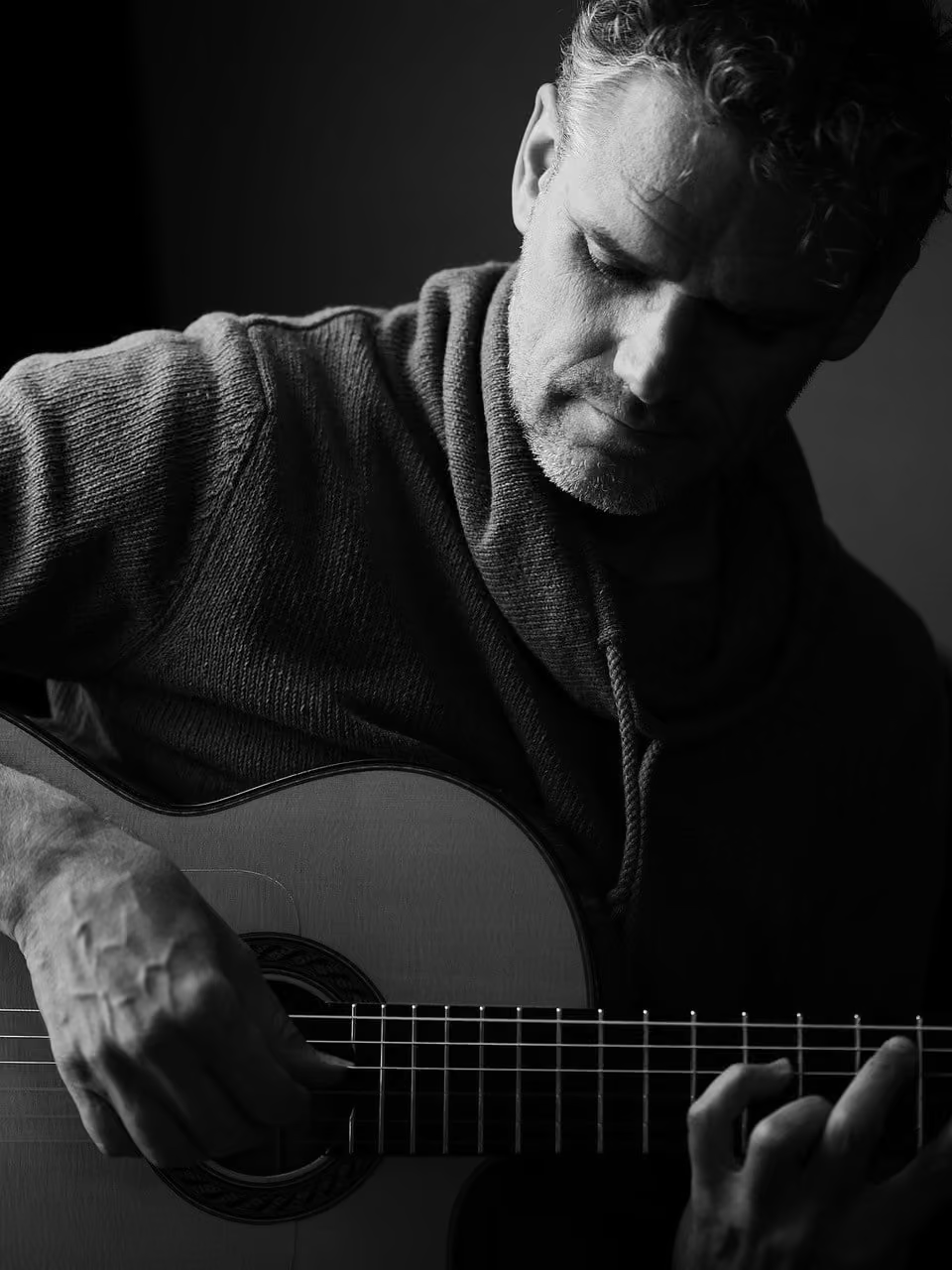
Guitarist Jesse Cook has built a remarkable career by making music that refuses to fit neatly into any one particular category. Blending elements of flamenco, jazz, world music and contemporary instrumental sounds, the Canadian artist has developed a distinctive style that’s taken him to stages around the globe. His music can be passionate and energetic one moment, beautifully restrained and introspective the next.
And if you ask Cook to describe exactly what kind of music he plays, even he has trouble finding the right words. That willingness to explore new musical territory has become one of the defining characteristics of Cook’s career. It’s also at the heart of his latest album, Past the Breakwater, a collection of quieter, more reflective compositions that finds the guitarist taking a decidedly different approach to his instrument.
I recently caught up with Cook to discuss the new album, his unlikely beginnings as a recording artist, the challenges of instrumental music and why, at 61, he still considers himself a student of the guitar.
Your music blends so many different styles and influences from around the world. How would you describe it to someone who’s never heard you before?
Jesse Cook: It’s really a global musical stew. I grew up being a huge Peter Gabriel fan. His album Passion was a tremendous influence on me. He brought musicians together from different parts of the world and combined electronics with instruments I’d never even heard before. It opened a door to an entirely different musical world.
In my twenties, I was primarily a composer, writing music for dance companies, theater and film. I never really intended to become a recording artist. Eventually, people started calling my house because they’d heard my music somewhere and wanted to buy a CD. I finally decided to make an album. We manufactured a thousand copies, and I remember thinking, “How am I ever going to sell all these?” But they were gone within a week. By the end of the month, I had a record deal in the United States. My life changed almost overnight.
What can you tell me about your new album, Past the Breakwater, and how it compares to your previous work?
Cook: I was listening to a lot of Bill Evans while making it, along with Miles Davis and other music. I’d written these very quiet pieces that initially were just two guitars. Eventually, I started thinking that maybe some double bass would sound nice. Then I asked a friend who’s an incredible violinist to play a couple of solos. Before I knew it, he was playing all over the record. The whole thing took on a life of its own. It’s quiet, introspective music.
One thing that fascinates me about instrumental music is how two people can hear the same piece and come away with completely different interpretations. Have fans ever told you what one of your songs meant to them and surprised you with their interpretation?
Cook: Absolutely. People sometimes come up to me and tell me these incredibly personal stories about what a song means to them. It’s wonderful that people can find their own meaning in the music. Instrumental music is a little unusual these days because most people listen to songs with a voice at the center. The advantage is that I’m not telling you a story. You get to bring your own story to the music. It also crosses borders more naturally. My music can connect with audiences around the world without language becoming a barrier.
Guitar playing is often as much about what you don’t play as what you do. As you’ve matured, have you become more interested in simplicity and leaving space rather than technical complexity?
Cook: Definitely, and that was really the whole idea behind this album. When I was younger, I practiced ten hours a day. I wanted to play like Paco de Lucía, Al Di Meola and John McLaughlin. I wanted that incredible speed, and I spent years developing it. The problem is that once you have that ability, it takes restraint not to use it. Sometimes it’s the notes you don’t play that give the music its meaning. With this album, I made a deal with myself that I wouldn’t play a single fast lick.
After all these years of recording, touring and exploring different styles, what still excites you about picking up the guitar?
Cook: I still feel like I’m trying to learn this instrument. The musical universe is infinite, and we’re all just chipping away at our little corner of it. Every day, I want to learn something new. I’m a huge fan of Tommy Emmanuel. Musically, we’re very different, but he’s a friend, and I’ve had the honor of sharing the stage with him. He’s a little older than I am, and I look at him and think, “That’s where I want to be in nine years.” He’s still out there loving music, putting on incredible shows and finding something new in the songs he plays every night. I find that incredibly inspiring.
If you could go back and have a conversation with the young Jesse Cook, just beginning his musical journey, what’s one piece of advice you’d give him?
Cook: There’s one huge thing I’d tell him, although it’s probably a little technical. I started out studying classical guitar when I was six. I had a wonderful teacher who wanted me entering competitions. Eventually, I moved toward jazz and rock and started playing electric guitar. When I was practicing ten hours a day in my late teens, I was using a guitar pick. It’s a wonderful way to play, but flamenco guitar really needs to be played with your fingers.
Now I’m 61, and I wish I’d spent those ten hours a day developing that technique instead. It’s like trying to learn a second language later in life. I can get my picking technique close to where I want it, but getting my fingers to the level of Paco de Lucía is another story. It drives me a little crazy, but I keep working at it. And I suppose that’s the beautiful thing about music. No matter how long you’ve been doing it, there’s always something more to learn.
James Wood is a freelance entertainment writer.
His new novel “The Seventh Echo” is available now from
Adverse City Publishing
© 2026 James Wood

Leave a Reply