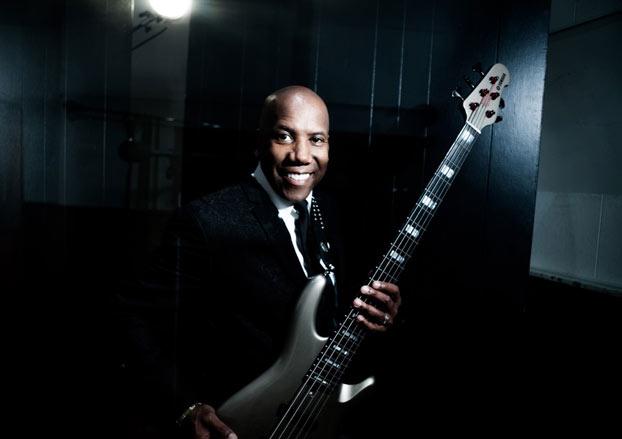
Bassist Nathan East’s resume reads like a music industry who’s who.
East, a founding member of renowned, contemporary jazz quartet Fourplay, also is one of the world’s most in-demand bassists with credits that include Eric Clapton, Michael Jackson, Phil Collins and Whitney Houston.
East’s sophomore solo album, Reverence, is a collection of original tracks and cover material spanning the R&B, pop, rock and jazz songbook. Included is a scorching cover of Earth, Wind & Fire’s “Serpentine Fire,” originally recorded in 1991 and featuring Eric Clapton on guitar and Phil Collins on drums. There’s also a soul-stirring interpretation of “Somewhere Over the Rainbow” that features East’s 16-year-old son, Noah, on piano.
I recently spoke with East about Reverence, his time performing with Eric Clapton, his gear and more.
Did you have a particular musical direction in mind for Reverence?
I always try to go in one direction, and it’s the same with Fourplay and all of the other projects I work on. You always try to go for sonic excellence. The idea is to keep the bar high in terms of quality and sound.
How did you determine what material to use for this project?
It’s a little more of a challenge as a bass player because you have to play bass and then any lead bass is in addition to it. So it’s actually two separate sets of basses on there. The idea is to find songs that lend themselves to that format in writing or covering. You always want to come up with something that will translate to the bass. The other thing I like to do is make records that are song-based and not just chops. Songs that touch a nerve or someone’s heart is also a big criteria.
Your cover of Earth, Wind and Fire’s “Serpentine Fire” actually began 25 years ago. How did it come about?
That was originally a project I was working on with my brother called Two Faces of East. We were living together at the time and doing work in the studio, and that particular song was one that we put together. Coincidentally, it was also when I was working with Phil Collins and Eric Clapton. I remember we flew over to England and asked if they’d like to lend their talents.
Sure enough, they put their stamp on it. We pretty much finished it up, but the project never got a deal and the song wound up sitting around in a basement on 2-inch tape.
Read the rest of my Interview with Nathan East by Clicking Here!
You could say it’s a guitar album that’s 600 years in the making—with a masterful, 21st-century approach.
I recently spoke to Menn about Abandon All Hope, her gear and more.
How did the Abandon All Hope project begin?
I’ve always liked the idea of art that incorporates other art and how you don’t have to just make music but can also make images that accompany it. I’m the daughter of a writer and grew up reading a lot of classic literature. I started playing around with the idea of doing something that would be the music to a work of literature I really liked.
Around that same time, Guitar Player Editor-in-Chief Michael Molenda reached out about doing a collaboration. I remember we met in a coffee shop and he handed me this sheet of paper that said, “Dante’s Inferno: A Journey in 11 Different Musical Moods,” and I was just blown away. It was one of those rare moments where I knew exactly what I was going to be doing for the next few years of my life. That’s how it came about.
You said you pored over orchestral scores and listened to a lot of music to prepare for this album. How did that help you?
I read scores every day, and where some people do crossword puzzles, I do counterpoint exercises [laughs]. But I didn’t want to take “x” from Led Zeppelin, “y” from Igor Stravinsky and “z” from Kate Bush. Instead, I listened to whatever inspired me. I’d listen to Stravinsky’s “Rite of Spring,” but I also listened to Roger Waters’ Amused to Death –a concept album he did with Jeff Beck. I really wanted to explore structure and the intense interplay between instruments.
You can read the rest of my Interview with Gretchen Menn by Clicking Here!
Def Leppard‘s new concert film, And There Will Be a Next Time: Live from Detroit, captures the power and raw energy of one of rock’s most dynamic and celebrated bands.
The disc, which was filmed at the DTE Energy Music Theatre in Clarkston, Michigan, includes a gaggle of hits from across the band’s 40-year career, including highlights from their monster albums—Pyromania and Hysteria—straight on through to their self-titled 2015 release.
I recently spoke with guitarist Phil Collen about Live from Detroit, the 30th anniversary of Hysteria, gear and more. You can check out the interview below.
And There Will Be a Next Time: Live from Detroit will be out February 10—and the band will be hitting the road again this spring.
What made the band decide to do a live project?
During this last tour, everyone—including the band—was saying this was the best they had ever heard Def Leppard. We knew we had to document it. We had also done Live: In the Round, In Your Face back in 1987 and knew we needed to update it. It was a no-brainer. But there was no real concept voyage behind it.
The first real sellout on the last tour was in Detroit, which has always been a brilliant market for the band. So we said, let’s record the most ravenous audience on that tour and the first sellout and update the whole thing, since it was all going so well. That was it.
Are there any extra nerves going into recording a live show, knowing there are no second chances?
Not so much nerves, but I do remember going over to the side and seeing a drone camera floating around by my head, filming me and taking photos. You get distracted and go, “This is not normal!” [laughs]. All of these kinds of things happen, but it’s all part of a live performance. There’s also going to be mistakes in live things, but it just shows that you’re human and it makes the record even more live.
This year marks the 30th anniversary of Hysteria. What was your biggest challenge when making that album?
The biggest challenge was that we had been working with Mutt Lange and then he had to go off and finish a prior commitment, which was the Cars’ album [Heartbeat City]. So we fended for ourselves for a while and it just wasn’t happening. Then when he came back into the fold, he had a vision of what it was going to sound like, and that’s when it really started clicking. It was a joy to actually hear it come together because it had been frustrating working on something for two years.
When Mutt came back in, we saw what he was trying to accomplish. It was something unique that I had never heard before. Now you hear it for what it is, but at the time it was the absolute perfect hybrid of a rock album into the pop market.
Read the rest of my Interview with Phil Collen By Clicking Here!
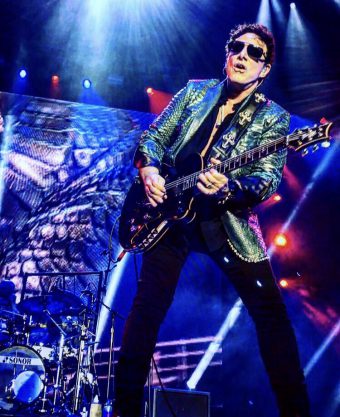
Last year, the longtime Journey guitarist—and the band’s only remaining founding member—celebrated another season of touring and was reunited with his longtime friend and mentor, Carlos Santana, for the Santana IV album and tour.
The new year is already off to a memorable start for Schon. In addition to the assortment of solo-related projects he’s working on, it was recently announced that Journey–whose current lineup includes Jonathan Cain (keyboards, vocals), Ross Valory (bass, vocals), Steve Smith (drums) and Arnel Pineda (lead vocals)—will be inducted to the Rock and Roll Hall of Fame in April alongside Yes, ELO, Pearl Jam, Joan Baez, Nile Rodgers and Tupac Shakur.
I recently spoke with Schon about Journey’s induction, his upcoming projects and more.
Did you ever think the day would come when Journey would be inducted into the Rock and Roll Hall of Fame?
I didn’t really think about it. We were up about 17 years ago, and when we weren’t nominated, I kind of forgot about it. One of the main things that got us in was our fans voting so hard. The fans and the music are the main things for me. They spoke and the Hall listened. It’s an honor to be in there and get the nod for some of the staples and cement we’ve made.Do you see Journey’s induction as a stepping stone for other “classic rock” bands to eventually get a nod?
I really can’t say because I have no clue what the voting process is. Personally, I’d love to see it be more fan-based. A hall of fame is about different artists and bands and the legacies they’ve left. Even if the people deciding don’t care for a certain type of music, the artists that have the credentials and sell millions of records deserve to be there.
Read the rest of my Interview with Neal Schon by Clicking Here.
The sold-out show, which took place in June, was highlighted by hit after hit—from “Crazy on You” and “Barracuda” to “Magic Man” and “Dreamboat Annie”—plus tracks from the band’s engaging new studio album, Beautiful Broken.
Besides Ann Wilson (vocals) and Nancy Wilson (guitar/vocals), the band that night included Ben Smith (drums), Dan Rothchild (bass), Craig Bartock (guitar), Chris Joyner (keyboards) and, of course, the Royal Philharmonic Orchestra conducted by Nick Davies.
I recently spoke with Nancy Wilson about the Royal Albert Hall performance, gear and the stories behind some of the band’s biggest hits.
When and how did the idea for a performance at the Royal Albert Hall originate?
We had been pushing the concept of bringing the band over to the U.K. and doing some shows for some time. That was when someone who had been handling big shows at Royal Albert Hall got wind that we were coming over and asked if we’d be interested in doing a World Symphony show. And we were like, “Uhm, yeah! I think we could manage that!” [laughs]. It all fell together very naturally.
What was the process like in terms of putting orchestration behind the band’s iconic songs?
It was a cool thing because we already had some standard charts from Paul Buckmaster, who worked us on Beautiful Broken. But we didn’t want to give it a pastoral kind of sound. We wanted more of a rock-symphony sound. We came over and had one day with Nick Davies looking over the charts and talking them over. We perused through them together and decided what to add and what take out.
The same day as the show was the only day we actually rehearsed with the orchestra. They’re so insanely talented. Once we got out there and saw how great it sounded in the room, we knew right away it was going to work. That’s when we said, “Ok, let’s go have some fun!”
Read the rest of my Interview with Nancy Wilson Here!
Glenn Hughes is an elusive artist with an uncanny ability to jam with Stevie Wonder one night and rock out with Disturbed the next. But perhaps no album showcases the real Glenn Hughes better than Resonate, his first solo album of new material in eight years.
With its groove-oriented, Detroit-style sound, the Rock and Roll Hall of Famer has made the album his fans have been longing for. Tracks like “Heavy,” “Landmines” and “Flow” spotlight Hughes’ limitless swagger, while “Long Time Gone” is acoustic and secretive.
I recently spoke with Hughes about the new album, his gear, Black Country Communion and a some of the more memorable moments of his career.
Resonate is your first solo album in eight years. Why such a long wait?
I’ve written three Black Country Communion albums, a California Breed album and bits and pieces with others artists. As I was recovering from double-knee transplants earlier this year, I was bedridden for a while and wrote this album. But I didn’t go in to write a solo album. I did it for cathartic/therapy reasons. If you know anything about me, you know I’m always writing.
To me, this album is one long song with 12 breaks. It’s a meaningful record because I sing about the human condition and what gets us through. I’m singing about my father’s death and I’m pissed off, but I’m also sensitive and you get to hear that in the tone of my voice in certain songs.
Read the rest of my Interview with Glenn Hughes by Clicking Here!
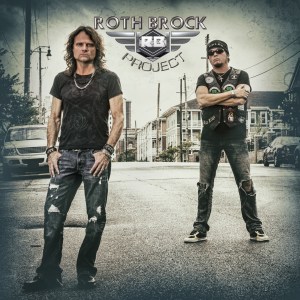
Guitarist John Roth first met vocalist Terry Brock in 2009 while working on Giant’s Promised Land record.
The pair immediately developed a musical bond, not to mention the songwriting chemistry that would eventually lead to their infectious debut album, Roth Brock Project.
For Roth—who gigs with Winger and Starship Featuring Mickey Thomas—and Brock (Giant, LeRoux, Strangeways), the 11-song collaboration of thundering guitars and powerhouse vocals pays homage to the inspired songwriting and style of Eighties arena rock while showcasing the talents of two seasoned veterans.
I recently spoke to Roth about the Roth Brock Project, his time with Starship and Winger, gear and more in this new interview.
How did your musical relationship with Terry Brock begin?
In 2009, I did a record with Giant called Promised Land. Dann Huff was the lead guitar player of the band, but he was too busy to do the record. He knew the guitar community, and I got the call to come in and do the record. Terry was the lead singer and he and I did some co-writing for the record and really hit it off.
How would you describe the Roth Brock Project in terms of its sound?
It’s classic, arena rock and roll. It’s got an Eighties vibe but with new gear and new recording technology. I wanted to deliver a record that has the elements of Winger, Starship and Giant. It’s inspired by that kind of sound.
What’s your writing process like?
I’ve written a few songs from musical ideas, but most are inspired when I hear a melody or lyric in my head. I’ll usually hear the chorus in my head first and then write what would go behind it and then move on to the verse and bridge. For me, it really comes chorus first.
You can read the rest of my Interview with John Roth by Clicking Here.
It was my senior year of high school in March of 1987 when rumors surfaced that Christian rockers, Stryper were coming to town. The band, which had already been generating a healthy buzz in both the Christian and secular/MTV worlds with the songs “Calling On You,” “Free,” “Honestly” and the title-track from their ‘To Hell With The Devil’ album, was out on tour supporting the release and would soon be rolling into The State Theatre in Easton, Pennsylvania.
My hometown.
Easton is a small town that borders the western end of New Jersey and lies somewhere in between the metropolitan cities of New York and Philadelphia. With a population of 26,000, the highlight of a night in Easton in 1987 consisted of listening to the freight trains rumble through the downtown or hanging out at the local McDonald’s on South Third Street.
Needless to say, when word got out that Stryper was coming to town it was a pretty big deal. And for a seventeen-year-old punk who had his own visions of rock stardom, it was also a dream come true. I had already worn out my cassette copy of THWTD learning it at guitar lesson, and now I had the chance of seeing the band perform it at a place within walking distance from my home. I immediately scrounged up every last dollar of lawn mowing money and the loose change from the sofa cushions and camped out in front of the venue. My reward? A single, front-row ticket to the show!
Stryper – Easton, PA 1987
I remember the band’s performance that night was amazing. Stryper– Michael Sweet, Robert Sweet, Oz Fox and Tim Gaines—wore their classic yellow and black uniforms, threw bibles into the audience and sang songs about positivity with soaring vocals and an infectious dual guitar attack. That show and tour remain one of the biggest highlights of my teenage years.
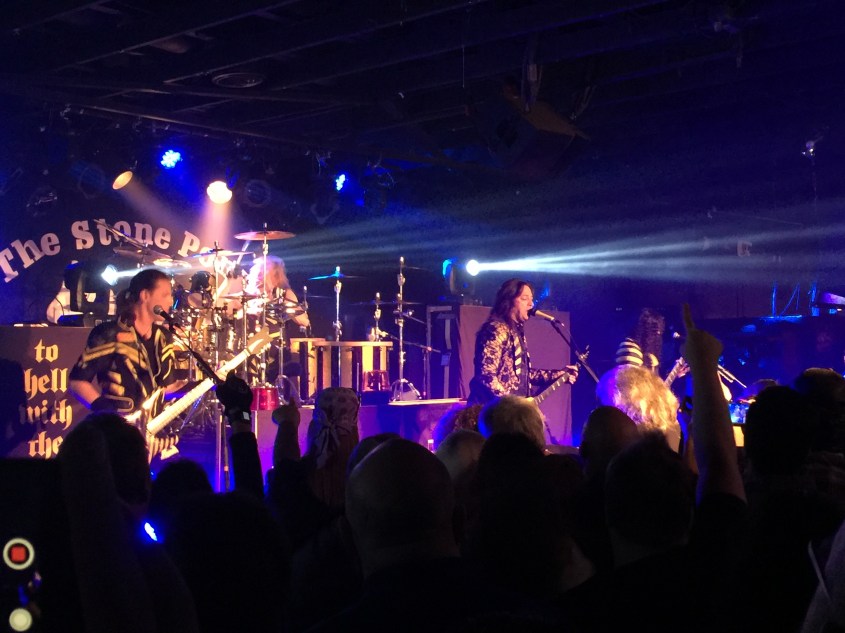
Fast-forward thirty years. I am now a middle-aged man, but still a punk-kid at heart. Dreams of rock stardom have been replaced by coffee, deadlines and a word processor. I may be a little thick in the middle now and my hairline may have receded, but my love of guitar and all things metal is still overflowing. So much so that last night I drove two hours outside the safe confines of Easton to catch Stryper performing the 30th anniversary of ‘To Hell With The Devil’ at The Stone Pony in Asbury, NJ.
Stryper – Asbury, NJ 2016. Photo courtesy: Dale Wilson
Oh sure, I’ve heard the band perform many of the songs from ‘To Hell With The Devil’ over the years –including most recently last April at the famous Whisky a Go Go in Los Angeles, but never in a celebration-style format of the entire album being performed in its entirety from front to back by those same original members, and I was not disappointed.
From the opening sounds of The Abyss (which kicks off ‘To Hell With Devil’) to the title-track, “Calling On You,” “Free” and “Honestly”, it was a time capsule of youth and music. Some of my other favorites from the album included “Holding On,” “More Than A Man” and the always emotional, “All of Me”.
As if seeing the band perform their biggest album in its entirely wasn’t enough, Stryper also went into an additional set of songs from their 33-year musical arsenal. Tracks like “Yahweh,” “God,” “Soldiers Under Command” and “Caught In the Middle” were fist pumping and magical, while the band’s infectious versions of Black Sabbath’s “Heaven and Hell” and KISS’ “Shout it Out Loud” were met with equally enthusiastic response.
The band ended their two-hour performance with the dual encore of “Reach Out” and “Makes Me Wanna Sing”, both from their ‘Soldiers Under Command’ album and capping off a celebration that included a little bit of everything.
In fact, about the only thing missing from Stryper’s Stone Pony set was their monster hit, “Always There For You” from their 1988 album, ‘In God We Trust’. But after experiencing the band many times over these last thirty years –both from small towns to the big cities–I can honestly say that it made no difference.
For me, Stryper will always be there.
Stryper Set List (Asbury Park, NJ)
Abyss (To Hell With The Devil)
To Hell With the Devil
Calling on You
Free
Honestly
The Way
Sing Along Song
Holding On
Rocking The World
All Of Me
More Than A Man
Battle Hymn of the Republic (pre-recorded)
Yahweh
In God We Trust
Heaven and Hell (Black Sabbath cover)
Shout It Out Loud (KISS cover)
God
Revelation
Caught in the Middle
Surrender
Soldiers Under Command
When multi-platinum, Christian rockers Stryper donned their iconic yellow and black costumes and kicked off their 30th Anniversary To Hell with the Devil Tour in September, they were greeted by legions of fans longing for one more taste of the band’s biggest album.
For most, this was the first time they’ve seen the band’s original line-up in full gear performing deep cuts like “Holding On” and “All of Me” in nearly three decades. A once in a lifetime opportunity to be sure.
Stryper
For metal fans who may not be familiar, Stryper’s “To Hell With The Devil” album is a masterpiece of 80’s metal. The Grammy-nominated, third studio release was also the first to achieve platinum status as well as giving the band — which consists of Michael Sweet (lead vocals/guitars), Robert Sweet (drums), Oz Foxx (guitars) and Tim Gaines (bass), crossover appeal to mainstream metal with songs like the title track, “Honestly,” “Calling On You” and “Free”.
For this tour, Stryper will be performing To Hell With The Devil in its entirely from start to finish, followed by another set of the band’s biggest and most well known hits.
I recently spoke with Michael Sweet about the To Hell With The Devil: 30th Anniversary Tour, his upcoming projects and some memorable moments of his career.
When you look back on the To Hell With The Devil album now with thirty years of perspective, what thoughts come to mind?
It was a special time and definitely the highlight and heyday of the band. I’ve always said that it was the album that took us from performing in theaters to arenas, and the song, “Honestly” literally took us from gold to platinum status. It was our biggest, most celebrated and popular album to this day, and just the fact that we’re doing it now with the original line-up thirty years later is mind boggling and I love it!
How has reaction been to the new tour?
It’s been fantastic. We start with a little video documentary of the band and its history. Then we come out and do To Hell With The Devil in its entirety. Then we take a five-minute break and come back out and do another full set after that. It’s almost a two-hour show.
What’s it been like revisiting some of these songs?
It’s been great. There are actually a few songs, like “Holding On,” “All of Me,” and “Rockin’ The World” that we haven’t played since the 80s. Playing them now every night is a reminder of just how cool those songs are and how much we missed playing them. The crowd loves them and the response has been phenomenal.
Let’s discuss a few tracks from To Hell With The Devil, starting with Honestly. Can you tell me how that song came about?
I had a Roland keyboard sitting in my garage that always inspired me to write piano ballads. I remember sitting down at it one day and playing some chords. It actually came together fairly quickly and wound up becoming the song that charted the highest of any we’ve ever released.
At the time, did you know it was going to be special?
I had a feeling about that song and the whole album actually. When we started tracking and listening back to the mixes I had a gut feeling it was going to be big and a turning point for the band.
How about the track, To Hell With The Devil?
Rob wanted to give the album that title, so I wrote the music and Rob and I wrote the words together. It’s an iconic title that a lot of people remember us for and a catch phrase people love to say. It’s a powerful statement because we believe that’s where he [The Devil] is going. The original album cover was very controversial because there was a pentagram being pulled from Satan’s neck and it upset a lot of the Christian bookstores that were carrying it. We wound up changing the artwork.
Calling on You.
That song is a good merge of pop sense and metal. It’s got this edge along with a great melody and harmonies. It was the first video we made for the album and the first that went to #1 on Dial MTV. It’s been a staple in our set since the 80s.
Michael Sweet
Your most recent solo album, One Sided War also received a lot of critical acclaim. Do you have plans to tour to support it next year?
Absolutely. I’m going to do some acoustic shows next year as well as ones and a full band. I’ll also be starting a new Sweet & Lynch album in February and I can’t wait to do it.
Are there any other projects you’re currently working on?
Right now, I’m working on some songs for Joel Hoekstra / Michael Sweet super group project. I’m also thinking about another new solo album already.
You’re one of few artists from the era who continues to write, record and create new music. What’s your reasoning behind it?
You know what it is? I’m still just as excited about it now as I was when I was sixteen. And it’s not just about the touring and performance as much as it is the writing and recording. Creating. I’m passionate about it.
Of all of the highlights of your career as an artist, are there any that stand out to you as most memorable?
As an artist, the one that pops in my mind instantly is the first performance I had with Boston [Note: Sweet performed as singer and guitarist for Boston from 2008-2011]. I remember it was a very sad night because we had been celebrating Brad Delp’s life and I was really nervous because I was stepping up to the plate and singing songs for Brad. I wasn’t sure how the fans would accept it, but I just remember singing the first song and hearing the crowd roar. It was a special, emotional moment for me. Of course with Stryper, there are so many. Just the days of performing in some of these venues, traveling and seeing the world together as a band. There are so many special moments.
Peter White released Groovin’, his third album of cover songs, today, October 28. This time around, the guitarist puts his unique spin on timeless tunes from the late Fifties through the early Eighties.
Taking up where White’s previous cover albums—Reflections (1994) and Playin’ Favorites (2006)—leave off, Groovin’ is a nostalgic and adventurous slice of instrumental groove and playful guitar melody.
The disc, which takes its title from the Rascals’ tropical-hued 1967 hit, is chock full of White’s instantly recognizable guitar sound. He applies it the Beatles’ “Here, There and Everywhere,” Stevie Wonder’s “Do I Do,” Marvin Gaye’s “I Heard It Through the Grapevine” and “Sleep Walk,” a Number 1 instrumental hit by Santo & Johnny from 1959.
I recently spoke with White about Groovin’, his gear and his time working with Al Stewart on Year of the Cat, which celebrated its 40th anniversary this year.
There’s a 23-year period of music you cover on Groovin’. Was there a particular theme or concept you had in mind when choosing songs?
There was never any great concept or theme, except for me to remind people that music was really good back then. For this album, I wanted to put together a collection of songs that I really like. They’re all songs with great melodies that work well on the guitar, but I wanted to approach them in a different way. I think if you can take a song everyone knows and give it a spin and make it your own, it really defines you as an artist.
Why did you choose to cover the Beatles’ “Here, There and Everywhere”?
I grew up learning to play guitar by listening to the Beatles on the radio. There are so many Beatles songs I love, but that particular one works so well on guitar. It’s very whimsical with a beautiful melody.
Read the rest of my Interview with Peter White Here!
 Interview with Nathan East by Clicking Here!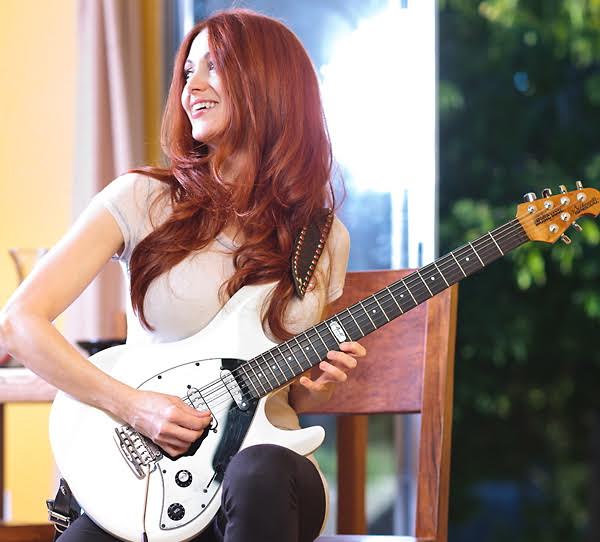



 Guitarist John Roth first met vocalist Terry Brock in 2009 while working on Giant’s Promised Land record.
 First, a little bit of perspective.


 go.Jimmy.go