Glenn Hughes is an elusive artist with an uncanny ability to jam with Stevie Wonder one night and rock out with Disturbed the next. But perhaps no album showcases the real Glenn Hughes better than Resonate, his first solo album of new material in eight years.
With its groove-oriented, Detroit-style sound, the Rock and Roll Hall of Famer has made the album his fans have been longing for. Tracks like “Heavy,” “Landmines” and “Flow” spotlight Hughes’ limitless swagger, while “Long Time Gone” is acoustic and secretive.
I recently spoke with Hughes about the new album, his gear, Black Country Communion and a some of the more memorable moments of his career.
Resonate is your first solo album in eight years. Why such a long wait?
I’ve written three Black Country Communion albums, a California Breed album and bits and pieces with others artists. As I was recovering from double-knee transplants earlier this year, I was bedridden for a while and wrote this album. But I didn’t go in to write a solo album. I did it for cathartic/therapy reasons. If you know anything about me, you know I’m always writing.
To me, this album is one long song with 12 breaks. It’s a meaningful record because I sing about the human condition and what gets us through. I’m singing about my father’s death and I’m pissed off, but I’m also sensitive and you get to hear that in the tone of my voice in certain songs.
Read the rest of my Interview with Glenn Hughes by Clicking Here!
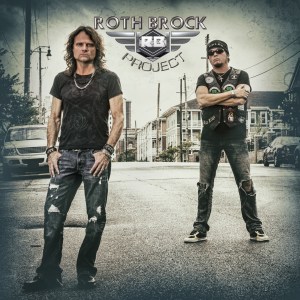
Guitarist John Roth first met vocalist Terry Brock in 2009 while working on Giant’s Promised Land record.
The pair immediately developed a musical bond, not to mention the songwriting chemistry that would eventually lead to their infectious debut album, Roth Brock Project.
For Roth—who gigs with Winger and Starship Featuring Mickey Thomas—and Brock (Giant, LeRoux, Strangeways), the 11-song collaboration of thundering guitars and powerhouse vocals pays homage to the inspired songwriting and style of Eighties arena rock while showcasing the talents of two seasoned veterans.
I recently spoke to Roth about the Roth Brock Project, his time with Starship and Winger, gear and more in this new interview.
How did your musical relationship with Terry Brock begin?
In 2009, I did a record with Giant called Promised Land. Dann Huff was the lead guitar player of the band, but he was too busy to do the record. He knew the guitar community, and I got the call to come in and do the record. Terry was the lead singer and he and I did some co-writing for the record and really hit it off.
How would you describe the Roth Brock Project in terms of its sound?
It’s classic, arena rock and roll. It’s got an Eighties vibe but with new gear and new recording technology. I wanted to deliver a record that has the elements of Winger, Starship and Giant. It’s inspired by that kind of sound.
What’s your writing process like?
I’ve written a few songs from musical ideas, but most are inspired when I hear a melody or lyric in my head. I’ll usually hear the chorus in my head first and then write what would go behind it and then move on to the verse and bridge. For me, it really comes chorus first.
You can read the rest of my Interview with John Roth by Clicking Here.
It was my senior year of high school in March of 1987 when rumors surfaced that Christian rockers, Stryper were coming to town. The band, which had already been generating a healthy buzz in both the Christian and secular/MTV worlds with the songs “Calling On You,” “Free,” “Honestly” and the title-track from their ‘To Hell With The Devil’ album, was out on tour supporting the release and would soon be rolling into The State Theatre in Easton, Pennsylvania.
My hometown.
Easton is a small town that borders the western end of New Jersey and lies somewhere in between the metropolitan cities of New York and Philadelphia. With a population of 26,000, the highlight of a night in Easton in 1987 consisted of listening to the freight trains rumble through the downtown or hanging out at the local McDonald’s on South Third Street.
Needless to say, when word got out that Stryper was coming to town it was a pretty big deal. And for a seventeen-year-old punk who had his own visions of rock stardom, it was also a dream come true. I had already worn out my cassette copy of THWTD learning it at guitar lesson, and now I had the chance of seeing the band perform it at a place within walking distance from my home. I immediately scrounged up every last dollar of lawn mowing money and the loose change from the sofa cushions and camped out in front of the venue. My reward? A single, front-row ticket to the show!
Stryper – Easton, PA 1987
I remember the band’s performance that night was amazing. Stryper– Michael Sweet, Robert Sweet, Oz Fox and Tim Gaines—wore their classic yellow and black uniforms, threw bibles into the audience and sang songs about positivity with soaring vocals and an infectious dual guitar attack. That show and tour remain one of the biggest highlights of my teenage years.
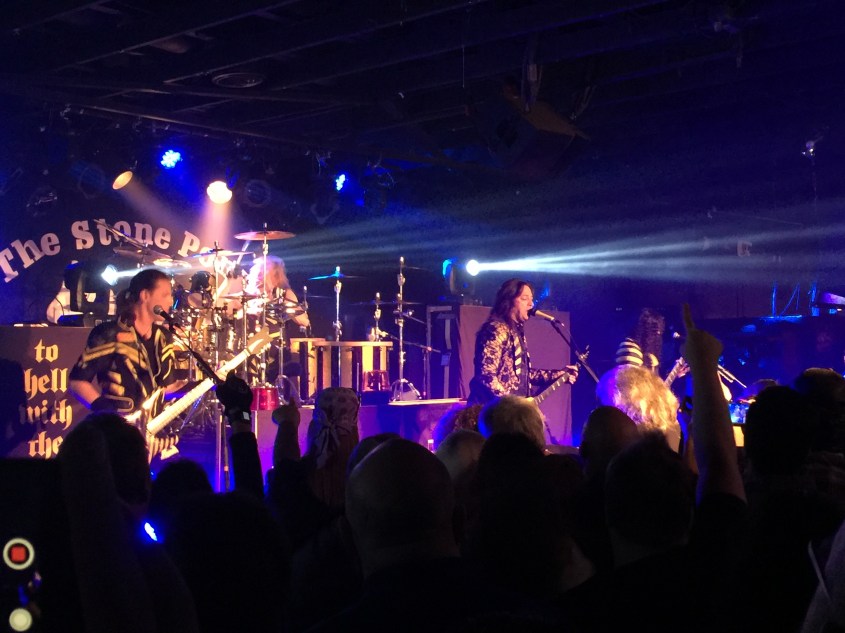
Fast-forward thirty years. I am now a middle-aged man, but still a punk-kid at heart. Dreams of rock stardom have been replaced by coffee, deadlines and a word processor. I may be a little thick in the middle now and my hairline may have receded, but my love of guitar and all things metal is still overflowing. So much so that last night I drove two hours outside the safe confines of Easton to catch Stryper performing the 30th anniversary of ‘To Hell With The Devil’ at The Stone Pony in Asbury, NJ.
Stryper – Asbury, NJ 2016. Photo courtesy: Dale Wilson
Oh sure, I’ve heard the band perform many of the songs from ‘To Hell With The Devil’ over the years –including most recently last April at the famous Whisky a Go Go in Los Angeles, but never in a celebration-style format of the entire album being performed in its entirety from front to back by those same original members, and I was not disappointed.
From the opening sounds of The Abyss (which kicks off ‘To Hell With Devil’) to the title-track, “Calling On You,” “Free” and “Honestly”, it was a time capsule of youth and music. Some of my other favorites from the album included “Holding On,” “More Than A Man” and the always emotional, “All of Me”.
As if seeing the band perform their biggest album in its entirely wasn’t enough, Stryper also went into an additional set of songs from their 33-year musical arsenal. Tracks like “Yahweh,” “God,” “Soldiers Under Command” and “Caught In the Middle” were fist pumping and magical, while the band’s infectious versions of Black Sabbath’s “Heaven and Hell” and KISS’ “Shout it Out Loud” were met with equally enthusiastic response.
The band ended their two-hour performance with the dual encore of “Reach Out” and “Makes Me Wanna Sing”, both from their ‘Soldiers Under Command’ album and capping off a celebration that included a little bit of everything.
In fact, about the only thing missing from Stryper’s Stone Pony set was their monster hit, “Always There For You” from their 1988 album, ‘In God We Trust’. But after experiencing the band many times over these last thirty years –both from small towns to the big cities–I can honestly say that it made no difference.
For me, Stryper will always be there.
Stryper Set List (Asbury Park, NJ)
Abyss (To Hell With The Devil)
To Hell With the Devil
Calling on You
Free
Honestly
The Way
Sing Along Song
Holding On
Rocking The World
All Of Me
More Than A Man
Battle Hymn of the Republic (pre-recorded)
Yahweh
In God We Trust
Heaven and Hell (Black Sabbath cover)
Shout It Out Loud (KISS cover)
God
Revelation
Caught in the Middle
Surrender
Soldiers Under Command
Bold, relevant and entertaining are just some of the adjectives used to describe the new Netflix original series, ‘Luke Cage’.
Fans of the Marvel universe already know know that “Luke Cage” follows the story of Carl Lucas (Mike Colter); a former convict with superhuman strength and unbreakable skin who now fights crime. It’s the perfect complement to other acclaimed Marvel themed Netflix shows like “Daredevil” and “Jessica Jones”.
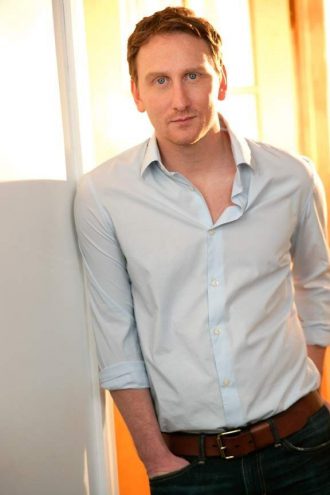
Actor Justin Swain plays Bailey in “Luke Cage”; an NYPD police officer who plays a pivotal role in tracking down the criminal mastermind responsible for the most recent crime outbreak. The series also stars Simone Missick as Misty Knight, Bailey’s NYPD colleague.
Already an accomplished actor and playwright, Swain has also written for film and television and is currently producing his first feature film, “Penance”.
I recently spoke with Swain about his role in “Luke Cage”, his career and more in the exclusive interview.
How did you become involved in “Luke Cage”?
It was pretty funny because Marvel is so secretive about everything they do that I didn’t even know I was auditioning for Luke Cage because the sides weren’t labeled. It was right before Labor Day weekend and I was heading out of town to visit my family when I got a call from my agent saying I booked it. I still didn’t know it was Luke Cage until I got an email later welcoming me the Marvel Cinematic Universe! I showed it to my wife and she was like “wait, what?!” [laughs]. Then I realized it was for Luke Cage. I was super excited because I’m a big fan of all the Marvel shows as well as the films. I was grateful to be a part of it.
What was it about the script that attracted you to the project?
When I went in for the audition I remember thinking, “these pages seem like a procedural cop show, but these lines have kind of an edge to them.” I think the writers did a great job of blending the Marvel Universe with a slick, edgy, grounded tone. Not only is it entertaining but I also think Cheo Hodari Coker [series creator], Marvel and Netflix have created a piece of art so relevant and necessary to today’s cultural conversation.
What can you tell me about your character, Bailey?
Getting the chance to play Bailey was so cool. The role grew as the season progressed and each time I was sent my pages it was an exciting surprise to see where the writers were taking it. He’s an analytical guy and I think that is a good balance and challenge for Misty who tends to go with her gut. I think he also wants to protect Misty; in little subtle ways Bailey is trying to make sure she doesn’t self destruct before they they are able to understand what is really going on with the whole Luke Cage situation.
One funny detail was his glasses. Early on I got some pages that said he wore glasses, so I quickly grabbed my wife’s glasses as I left the house. When we started shooting the scene, I was wearing the glasses and looking at the computer screen. It was my wife’s prescription so as I stared at the computer screen I started to feel sick. I couldn’t wear the glasses for too long so I had to take them off during the scene and it started to become a little Bailey character thing [laughs].
What was it like working on a Marvel production?
Just getting a chance to work with talented actors like Simone Missick, Mike Colter, Rosario Dawson and Karen Pittman was a gift. It was also awesome to work with the showrunner Cheo Hodari Coker and the whole writing staff Jason Horwitch and Aida Marshaka Croal. They were so gracious and accessible during filming and are just incredibly creative and talented people. Then they brought on amazing directors like Paul McGuigan to do the pilot, Steven Sujik, and then Clark Johnson directed the finale. Just a really great group of people to work with.
What was it like getting to work with Simone Missick?
She’s an amazing actor. I thought she did a fantastic job stepping into an iconic character and making it her own. She was really fun to work with, always accessible, a really kind person. She was very giving as a scene partner. Working with her made my job very easy!
Did you always know that you wanted a career in entertainment? Was it something you always aspired to do?
I acted in plays when I was kid and pursued it into high school as well. I think for me, it was a way to connect to people and, coming from such a small town, I really cherished that. When it came time to pick a college I remember my mom asking me if I wanted to go to school for acting or visual arts, because I had also grown up painting as well. I think that’s when I made the choice. I said, “I want to go for acting.” That was it.
What are some of the differences between doing a series like Luke Cage as opposed to doing theater or a feature film?
Shooting a series like Luke Cage seemed to me to be more like shooting a film. The set was loose and sometimes you could throw in some ad-libs and — if you were able to come up with something good– they would keep it. Theater is a completely different animal; it’s more athletic in a way. You have to be on for it every night. To use a racing analogy, I’d say doing film/TV work is like sprinting — you have to go hard, fast and be precise. Theater is more like endurance work — you have to buckle in and maintain the character straight through for two hours every night.
Are there any other projects you’re currently working on?
I’m currently looking into working on a virtual reality project. I’m also finishing up the development of a new series about a group of fishermen in Massachusetts who are over regulated by the government so they turn to smuggling to survive. There are lots of opportunities on the horizon!
What excites you the most about this next phase of your career?
Luke Cage was a great experience and I have no idea what the rest of the series is going to look like. They are doing The Defenders now and Luke Cage is part of that gigantic Marvel world. It’s also all intertwined with Jessica Jones and Daredevil. Marvel has big plan for the whole Marvel Universe so I’m excited to see where it’s going and what is happening next!
Written and directed by Andrew Cymek, “Night Cries” is a psychological thriller about a man searching for his wife in a post-apocalyptic world.
The film took home the Best Screenplay award when it premiered at the Blood In The Snow film festival last November, and for good reason. Cymek and his partner, Brigitte Kingsley have become masters at delivering multi-layered stories with beautiful cinematography and passionate musical scores to all of their projects. “Night Cries” is a thought provoking film that plays on the ultimate question we have in life, and just how far we’d go to find our one true love.
The beautiful Kingsley plays the role of Sara Morgan in “Night Cries”. A strong, defiant wife and mother who finds herself lost in a world she doesn’t recognize. The film also stars Andrew Cymek, Colin Mochrie, Lauren Williams and Jacob Blair.
Night Cries is available now for pre-order now in various packages and will be shipped on December 14. This will be followed by a world wide digital release in the New Year.
I recently spoke with Kingsley about “Night Cries” and more in this exclusive interview.
How did the Night Cries project originally come about?
I first met Andrew back in 1999 when he and I were both in school. He was doing a ten-minute short called “Night Cries” that was inspired by these characters. We shot the short and I remember thinking that it was a really cool story. Now fast forward to 2012 when we started our company, Good Soldier Films. We were trying to figure out a good pilot project to launch the company with and decided to create a “Night Cries” feature. Andrew had already worked out the characters in his head. He wrote the feature and we jumped into it.
In your opinion, what makes the story of “Night Cries” so special?
I think the main push is the cyclical feeling you get when you watch it. There’s so much thought that went into the imagery and ideas behind the story and you see that in various ways throughout the production. It’s a very in depth look at life and death. Andrew wanted to forward the idea of the end of the world, but he also wanted to go more into a personal apocalypse when someone’s world ends. There’s a lot of layers to it and that’s what makes it so cool.
What was the casting process like?
A lot of the characters were written with certain people already in mind. Colin Mochrie was someone we instantly knew we wanted to work with. He has so much depth to his acting but doesn’t often have a chance to do things this sinister. We thought he’d be great fit for the role of The Hat. A lot the other actors, like Lauren (Angel) Williams and Jacob Blair, we had worked with on other projects before.
You mentioned Colin Mochrie. What was it like working with him?
Colin is one of my favorite people in the world. He’s so defined as an actor and comes extremely prepared. He was only out for a few days but was such a pleasure to be around.
A lot of attention is paid to the music and cinematography in this film. Can you speak a little as to how these are important to you?
They’re both very important to us. We’ve worked with Josh Fraiman (cinematographer) for several years on various projects. Although we had a small crew we made sure to take the time to give him the beautiful shots he wanted. When it comes to the music, Emir Isilay (our composer) is an extremely talented guy. Andrew sent him the ideas of what he had in mind and when the music came back the first time around he had tears in his eyes because it was exactly what he had envisioned. Going from one world to another and bringing sense to a certain level. It was epic and beautiful.
What are some of the other projects you’re currently working on?
“The Man In the Shadows” is another film that’s available for pre-order. It’s a story by Adam Tomlinson that’s based on the real phenomenon of shadow people. Adam had experienced a man in a hat and coat that that had haunted him a few times. He looked into it and found that it’s actually an apparition that happens to many people around the world. He wrote a script that’s partially based on his experiences and the people he had spoken to. “Country Crush” is also coming out in the New Year. It’s a country musical that stars Jana Cramer, Madeline Merlo and Munroe Chambers.
As a filmmaker, what satisfies you the most about seeing a completed project?
As a filmmaker, the thing you want is for your work to mean something. So when a stranger comes up and tells you that your work touched them or made them realize something they hadn’t thought about before, that’s what matters.
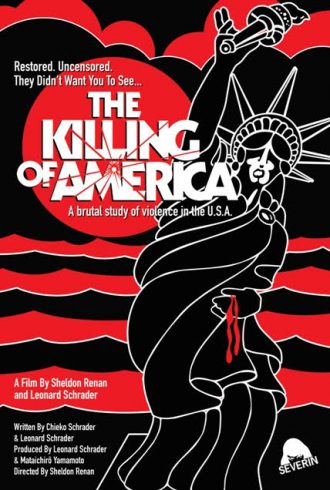
When they asked Sheldon Renan to watch The Killing of America at a recent film festival, it was the first time the director had seen the film he had worked on since it was released thirty-five years ago. Afterwards, Renan remarked how amazed he was at how well the film played more than three decades later and how relevant its message still was in 21st century America.
Originally produced in 1981, Renan, along with co-producers Leonard Schrader and Matachiro Yamamoto set out to document America’s seemingly unending love affair with violence. From iconic newsreel footage to chilling interviews with convicted killers, Renan and his team sought to depict a terrifying aspect of Reagan-era America through a brutally honest lens. Despite some limited theatrical showings, the documentary has never received an official American release, until now.
The Killing of America is told in narrative style. Describing horrifically tragic events of the last half-century with pinpoint accuracy and chilling realism. But perhaps more than anything else, the film is an ominous reminder that social, economic and racial injustice as well as the proliferation of personal firearms has not abated in the thirty-five years since the documentary’s creation.
I recently spoke with Renan about The Killing of America and more in this exclusive interview.
How did you become involved in The Killing of America project?
I had done a lot of heavy research in the world of homicide and gun culture in preparation for a script I was working on when I met Leonard Schrader and Matachiro Yamamoto. They wanted to use the film Faces of Death as a springboard for this new project they were working on about homicide and violence. They were looking to put together a team of young filmmakers that were very ambitions and loved films, but they were having trouble finding clips. I had come out of the film archivist world and put together some clips for them. It was exactly what they were looking for and they asked me if I could help them.
What was the initial reaction like to the film when it premiered and why has it never received a proper U.S. release until now?
The film was initially made to be released in the fall in Japan. It was the seventh highest grosser there that year as well as a hit in a number of other countries. The company that bought the rights to distribute the film in America did a preview for coming attractions, but a high ranking official thought it was taboo and would terrify people. I even remember at the cast and crew screening about a third of the people walked out.
Aside from the fashion and vintage cars, the documentary looks like something you’d see on the news today.
Although it looks like a documentary, nothing is fake or has been rigged. The only change is that the sound has been enhanced in some places. Len’s writing is incredible and Chuck Riley’s voice in the narration could cut through metal. He was telling a complete story. A narrative arc about the subject. By the end, you’re inside the mind of killers, which isn’t very comfortable.
What are some of the parallels you see today as compared to when the film was made?
It’s the same pattern. The main thing is that the person pulling the trigger is usually someone who has a very bad sense of self-esteem. I remember the L.A. coroner telling us that it comes down to the person deciding whether to kill themselves or someone else. When you’re unhappy about something in yourself, you tend to project that flaw onto other people.
What have you learned about us as a society by making this film and seeing it again thirty-five years later?
You observe that if you don’t treat people well or if they’re not raised well and given structure and self-esteem, you’re going to pay for it later in a very bad way. You also can’t let emotion rule you because the long-term effects can be enormously devastating. The third thing is that people have to have the right to have access to and have guns as it says in the Constitution–but not one that can punch a hole in a tank and not without background checks.
Is there a message you think viewers should take away from watching The Killing of America?
If you’ve had a lot of violence in your life this is a film you shouldn’t see or show to your kids, as you’ll find it very upsetting. Early on, the coroner’s office allowed us to film and the day we were there L.A. was in the middle of a crime wave and they were running six autopsy tables at one time. This is a complex phenomenon and something you can’t run away from. This film is one step in thinking about and understanding violence and how epidemic it is in American culture and recognizing that you cannot escape the connection between it and the easy availability of guns. People also need to be careful about this loose talk about destroying our infrastructure because you don’t like one party, candidate or president. Because what lies on the other side is nothing we want to go back to.
When multi-platinum, Christian rockers Stryper donned their iconic yellow and black costumes and kicked off their 30th Anniversary To Hell with the Devil Tour in September, they were greeted by legions of fans longing for one more taste of the band’s biggest album.
For most, this was the first time they’ve seen the band’s original line-up in full gear performing deep cuts like “Holding On” and “All of Me” in nearly three decades. A once in a lifetime opportunity to be sure.
Stryper
For metal fans who may not be familiar, Stryper’s “To Hell With The Devil” album is a masterpiece of 80’s metal. The Grammy-nominated, third studio release was also the first to achieve platinum status as well as giving the band — which consists of Michael Sweet (lead vocals/guitars), Robert Sweet (drums), Oz Foxx (guitars) and Tim Gaines (bass), crossover appeal to mainstream metal with songs like the title track, “Honestly,” “Calling On You” and “Free”.
For this tour, Stryper will be performing To Hell With The Devil in its entirely from start to finish, followed by another set of the band’s biggest and most well known hits.
I recently spoke with Michael Sweet about the To Hell With The Devil: 30th Anniversary Tour, his upcoming projects and some memorable moments of his career.
When you look back on the To Hell With The Devil album now with thirty years of perspective, what thoughts come to mind?
It was a special time and definitely the highlight and heyday of the band. I’ve always said that it was the album that took us from performing in theaters to arenas, and the song, “Honestly” literally took us from gold to platinum status. It was our biggest, most celebrated and popular album to this day, and just the fact that we’re doing it now with the original line-up thirty years later is mind boggling and I love it!
How has reaction been to the new tour?
It’s been fantastic. We start with a little video documentary of the band and its history. Then we come out and do To Hell With The Devil in its entirety. Then we take a five-minute break and come back out and do another full set after that. It’s almost a two-hour show.
What’s it been like revisiting some of these songs?
It’s been great. There are actually a few songs, like “Holding On,” “All of Me,” and “Rockin’ The World” that we haven’t played since the 80s. Playing them now every night is a reminder of just how cool those songs are and how much we missed playing them. The crowd loves them and the response has been phenomenal.
Let’s discuss a few tracks from To Hell With The Devil, starting with Honestly. Can you tell me how that song came about?
I had a Roland keyboard sitting in my garage that always inspired me to write piano ballads. I remember sitting down at it one day and playing some chords. It actually came together fairly quickly and wound up becoming the song that charted the highest of any we’ve ever released.
At the time, did you know it was going to be special?
I had a feeling about that song and the whole album actually. When we started tracking and listening back to the mixes I had a gut feeling it was going to be big and a turning point for the band.
How about the track, To Hell With The Devil?
Rob wanted to give the album that title, so I wrote the music and Rob and I wrote the words together. It’s an iconic title that a lot of people remember us for and a catch phrase people love to say. It’s a powerful statement because we believe that’s where he [The Devil] is going. The original album cover was very controversial because there was a pentagram being pulled from Satan’s neck and it upset a lot of the Christian bookstores that were carrying it. We wound up changing the artwork.
Calling on You.
That song is a good merge of pop sense and metal. It’s got this edge along with a great melody and harmonies. It was the first video we made for the album and the first that went to #1 on Dial MTV. It’s been a staple in our set since the 80s.
Michael Sweet
Your most recent solo album, One Sided War also received a lot of critical acclaim. Do you have plans to tour to support it next year?
Absolutely. I’m going to do some acoustic shows next year as well as ones and a full band. I’ll also be starting a new Sweet & Lynch album in February and I can’t wait to do it.
Are there any other projects you’re currently working on?
Right now, I’m working on some songs for Joel Hoekstra / Michael Sweet super group project. I’m also thinking about another new solo album already.
You’re one of few artists from the era who continues to write, record and create new music. What’s your reasoning behind it?
You know what it is? I’m still just as excited about it now as I was when I was sixteen. And it’s not just about the touring and performance as much as it is the writing and recording. Creating. I’m passionate about it.
Of all of the highlights of your career as an artist, are there any that stand out to you as most memorable?
As an artist, the one that pops in my mind instantly is the first performance I had with Boston [Note: Sweet performed as singer and guitarist for Boston from 2008-2011]. I remember it was a very sad night because we had been celebrating Brad Delp’s life and I was really nervous because I was stepping up to the plate and singing songs for Brad. I wasn’t sure how the fans would accept it, but I just remember singing the first song and hearing the crowd roar. It was a special, emotional moment for me. Of course with Stryper, there are so many. Just the days of performing in some of these venues, traveling and seeing the world together as a band. There are so many special moments.
Peter White released Groovin’, his third album of cover songs, today, October 28. This time around, the guitarist puts his unique spin on timeless tunes from the late Fifties through the early Eighties.
Taking up where White’s previous cover albums—Reflections (1994) and Playin’ Favorites (2006)—leave off, Groovin’ is a nostalgic and adventurous slice of instrumental groove and playful guitar melody.
The disc, which takes its title from the Rascals’ tropical-hued 1967 hit, is chock full of White’s instantly recognizable guitar sound. He applies it the Beatles’ “Here, There and Everywhere,” Stevie Wonder’s “Do I Do,” Marvin Gaye’s “I Heard It Through the Grapevine” and “Sleep Walk,” a Number 1 instrumental hit by Santo & Johnny from 1959.
I recently spoke with White about Groovin’, his gear and his time working with Al Stewart on Year of the Cat, which celebrated its 40th anniversary this year.
There’s a 23-year period of music you cover on Groovin’. Was there a particular theme or concept you had in mind when choosing songs?
There was never any great concept or theme, except for me to remind people that music was really good back then. For this album, I wanted to put together a collection of songs that I really like. They’re all songs with great melodies that work well on the guitar, but I wanted to approach them in a different way. I think if you can take a song everyone knows and give it a spin and make it your own, it really defines you as an artist.
Why did you choose to cover the Beatles’ “Here, There and Everywhere”?
I grew up learning to play guitar by listening to the Beatles on the radio. There are so many Beatles songs I love, but that particular one works so well on guitar. It’s very whimsical with a beautiful melody.
Read the rest of my Interview with Peter White Here!
Andy Timmons Band’s eighth album, Theme from a Perfect World, is an inspired, guitar-driven affair made up of 10 hook-filled instrumentals that are sure to satisfy even the pickiest of guitarists.
Produced by Timmons and his longtime bassist, Mike Daane, Perfect World is the ideal balance of melodic virtuosity and inspired songwriting.
I recently caught up with the busy guitarist to ask him about Theme from a Perfect World, his gear and memorable moments from his career.
How would you describe Theme from a Perfect World in terms of its sound and how it relates to some of your previous work?
I think it’s a bit of a departure from my last two records [Revolution and Andy Timmons Band Plays Sgt. Pepper]. I remember when we recorded Revolution and I was listening to the basic tracks. I wasn’t feeling inspired, but then I remembered something Steve Vai told me; he said he loved those earlier sessions I did when I was recording songs that just had guitar, bass and drums—ones where you could hear the fingers on the frets and there wasn’t a lot of stuff going on.
That stuck in my mind, and I asked myself, what if I switched gears and did the whole record like that? Just stripping it down to a one-guitar performance and assimilating all of the important elements into one. It became fun and a challenge. That same idea spilled over to the Beatles songs.
This new album is in the direction of the last two records in that we’re still keeping things as natural and organic as possible, but we also gave ourselves the “keys to the kingdom.” It’s given it a vintage kind of feel. I’m very proud of the songwriting and the playing on this record.
Is there a different way you approach writing an instrumental album as opposed to one with vocals?
I don’t find it that much different. Things that have resonated with me a certain way are stored in muscle memory and my melodic ear will always steer me. As a writer and improviser, you’re always trying to create an “in the moment,” but with just music, you’re not confined to any limitation and can go much deeper. And the deeper your connection is to the instrument, the better your ability is to do that.
You can read the rest of my Interview with Andy Timmons by Clicking Here!
Veronica Mannion is fast becoming a rising force in the celestial world of the Hollywood scene.
The beautiful actress–who’s also spent time as a standup comedienne–can currently be seen in the HBO comedy series, Insecure. The show, based on series creator and star Issa Rae’s web series “Awkward Black Girl”, follows the exploits and racy tribulations of a modern-day African-American woman.
Mannion plays the recurring role of Kitty—Issa’s co-worker—who tries to be her friend throughout the season but almost sabotages one of Issa’s work projects due to her gossiping and prejudiced skepticism.
In additional to an impressive resume that includes stints on Showtime’s “Masters of Sex” and FX’s “American Horror Story”, Mannion has also written, directed and appeared in the film “Booze, Boys & Brownies”.
I recently spoke with her about Insecure, her career and more in this exclusive new interview.
How did your involvement in “Insecure” come about?
I was one of the lucky chosen to audition for the pilot. They booked me off tape so I didn’t even have to come in for a callback. I shot the pilot last September and then heard they wrote me into four more episodes in April. It was a dream come true scenario!
What was it that attracted you to the role?
Kitty’s the kind of person who tries too hard. She may be sweet but ends up coming across as annoying and judgmental. I think that I have that side to me, so it’s been fun channeling that version of myself.
What else can you tell me about her?
Kitty works with Issa at We Got Ya’ll and really thinks she’s making a difference at her desk job helping underprivileged kids. She loves anything vintage, her co-worker Ken, and cats… obviously.
How would you describe the series?
“Insecure” follows the awkward experiences and racy tribulations of a modern-day African-American woman, Issa Rae, and her best friend, Molly. Some people are saying it’s like the black “GIRLS” or “Sex In The City”, but I think it’s what every HBO show wants to be: laugh out loud funny, authentic and with a lot of heart!
As a woman, what’s its like for you to be a part of a series that was inspired and created by Issa?
Issa is an inspiration, not only to me but I think for all of us on set and for women everywhere. She’s so talented, funny, real and kind. She’s created not just an amazing show but a great atmosphere on set… and I think she’s going to change the world!
What’s the filming process like and working with Issa?
A typical day can last from six to twelve hours. Since this was the first season the way it was shot and the tone (and even what our characters were eating or doing) was all a collaborative feeling. Issa definitely has a strong vision and point of view, but she was also open to people bringing themselves to the role. Everyone contributed to making Insecure the best it could be. It felt like one big family!
Did you always know that you wanted a career in entertainment? Was it something you always aspired to do?
I was one of those little girls singing in my living room, playing dress up and dreaming about the big lights of Hollywood. My mom taught me that your thoughts create and to go for what you love to do. So here I am!
How did you become involved in doing stand-up comedy?
I started doing stand up when I moved to LA as a way to get on stage and get my acting fix! I realized that you don’t just have to tell jokes – you can do characters, sing, or even improvise with the audience. Stand up became my performance outlet. Somewhere where I could feel like I had power over my career just by making people laugh.
What’s the most challenging part of doing stand-up? What do you enjoy the most about it?
Probably the scene of it all and breaking through that next barrier. I don’t enjoy the bros, or the drunk hecklers but I love the immediate response of the crowd! You really have to be present during stand up because people will glaze over if you just go on stage and go on autopilot. You really have to be on your toes.
Are there any other projects you’re currently working on?
I just filmed a small role on “FEUD!” opposite Susan Sarandon and Jessica Lange. It’s Ryan Murphy’s new FX show that premieres next year! You can catch me in Episode 2.
What excites you the most about the new series and this next chapter of your career? What are you most looking forward to?
I feel very lucky to see my face on HBO! I remember watching the second episode and thinking, “This is crazy! I’ve watched HBO all my life wanting to be on it and there’s my face!” I’m looking forward to more fun parts and more work with talented, good people! Whatever happens, I’m definitely enjoying the ride and feel so lucky to be apart of such a new awesome show. I hope you watch and love it as much as I do!

 Interview with Glenn Hughes by Clicking Here!
 Guitarist John Roth first met vocalist Terry Brock in 2009 while working on Giant’s Promised Land record.
 First, a little bit of perspective.
 Bold, relevant and entertaining are just some of the adjectives used to describe the new Netflix original series, ‘Luke Cage’.

 When they asked Sheldon Renan to watch The Killing of America at a recent film festival, it was the first time the director had seen the film he had worked on since it was released thirty-five years ago. Afterwards, Renan remarked how amazed he was at how well the film played more than three decades later and how relevant its message still was in 21st century America.



 go.Jimmy.go