Category: Guitar World Interviews

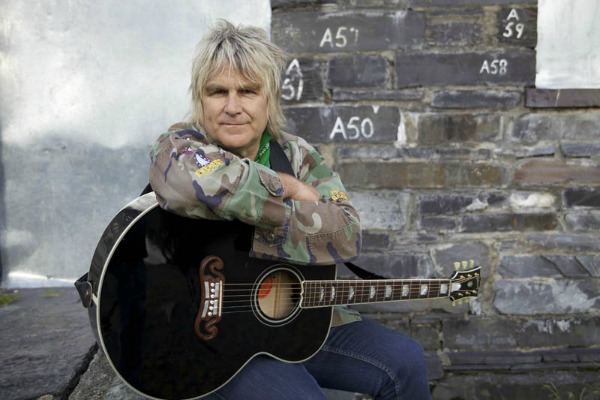
The Alarm’s Mike Peters Discusses His Inspiring New Documentary, ‘Man in the Camo Jacket’

The story behind Mike Peters’ inspiring new documentary, Man in the Camo Jacket, actually begins with the music of the Alarm.

Peters’ will to live also comes through his charity, the Love Hope Strength Foundation, which raises funds and awareness for cancer centers around the world through music-related events and promotions. To date, LHS has added more than 129,000 music fans to the bone marrow registry, helping to find more than 2,400 potential lifesaving matches.

Man in the Camo Jacket will have its U.S. premiere in Los Angeles on April 22 and in New York on April 29. This will be followed by the Alarm’s run of live dates as part of the Vans Warped Tour.

I recently spoke to Peters about Man in the Camo Jacket, the Alarm’s upcoming tour, new music and more.

What inspired Man in the Camo Jacket?

The genesis of the film happened when I was approached by Russ Kendall from Kaleidoscope Pictures. He had been commissioned to make a series of programs for a film called A Song That Changed My Life. Russ and his crew came to Wales to film my portion. While he was there, I told him the story about our work with the charity and the bone marrow drive and he became enthralled with the whole Love, Strength, Hope story. That’s when he said, “Mike, this is more than a TV show. This has to become a film.”

He started the drive with the other producers [James Chippendale, Stash Slionski and Alex Coletti] and put the story together. The film is the coming together of a lot of people who had faith in the band and me as an individual and stood behind me through my cancer struggles, and also about the people who got on board and volunteered to give their love, hope, strength back to the world.

What’s the story behind the camouflage jacket?

When I was first diagnosed in 1995, I was due to have a bone marrow transplant. But I told the doctors I had an American tour in a few days and couldn’t cancel it. A friend of mine gave me a book about self-healing to read on the way over, and there was a chapter about a girl who had a brain tumor and created a Pac-Man game in her mind to eat it.

She wound up going into spontaneous remission and cured herself through the power of her mind. It really connected with me and made me realize I needed a defense mechanism of my own. I thought that if I was going to war with the cancer, I was going to buy an army jacket and wouldn’t take it off until I was cured.

One of the interesting parts of your musical journey was when one of your early bands, Seventeen, dissolved. It was the day you were told by the band’s manager that you’d never amount to anything musically.

That was the bottom and a terrible day, because it was also the day John Lennon died. But I saw something in myself that day. Up to that point, all I was trying to do through the band was get a record deal. I realized it shouldn’t just be about that. I thought we’ve got to put our ideals across and give something tangible to our audience through our music. Something where they can say, “Wow! Those guys mean it. Let’s apply that to our lives as well.”

I remember walking away from that moment with no anger or bitterness and later telling him, “You’re wrong. I’ll prove you wrong.” It was a wakeup call and a turning point that shocked me into real action instead of just going for a ride.

Read the rest of my

Interview with Mike Peters by Clicking Here!

New James Hetfield Biography: An Interview with Author Mark Eglinton

Mark Eglinton’s So Let It Be Written: The Biography of Metallica’s James Hetfield is the first biography of a living member of Metallica.

In the book, which will hit shelves April 11 via Lesser Gods, Eglinton uses exclusive, firsthand interviews with artists and celebrities who have crossed paths with the guitarist, including other members of Metallica, Testament’s Chuck Billy (who wrote the book’s foreword), Charlie Benante (Anthrax), Jerry Cantrell (Alice In Chains) and Rex Brown (Pantera), to construct the definitive account of Hetfield—at least up to this point.

Before becoming one of metal’s biggest personalities, Hetfield overcame several barriers throughout his adolescence, including his parents’ divorce, his mother’s death and severe alcoholism. Eglinton’s book provides the ultimate insider’s look at the man who turned it all around and became a metal god.

I recently spoke to Eglinton about So Let It Be Written, and you can check out our interview below. For more about Eglinton, visit mark-eglinton.com.

What made you decide to write a biography about Hetfield?

I’ve been a fan of the band my whole life, and this idea probably goes back to when I met James for the first time in 1986. I met James and Cliff Burton when Metallica played in my hometown, Edinburgh, Scotland. This was the week before Cliff died, so in retrospect, it was a pretty significant meeting.

James struck me as someone who had a lot of thinking going on but maybe didn’t know how to express it. As time went on, it became an interesting idea to see how he had evolved. On a basic level, it also surprised me that no biography had ever been written about him. Those two things in combination made it a pretty easy decision.

What made the music of Metallica so special for you back then?

I was into a lot of the bands that were around at that time—1984 to ’86—but was looking for something a bit heavier. When I heard Metallica for the first time, it was like inventing the wheel. It was a sound that was so different, so new and so aggressive. It wasn’t radically different from heavy metal but it was being done in a way that no one had ever done before. They’ve always maintained that interest for me.

Read the rest of my
Interview with Mark Eglinton by Clicking Here!

Richie Kotzen Discusses Gear and New Album, ‘Salting Earth’

Photo: Julia Lage

When working on Salting Earth, his 21st solo effort, triple-threat songwriter, guitarist and vocalist Richie Kotzen tossed convention on its ear by taking one step back in order to move two steps forward.

“It’s something I really needed to do in order to reset myself,” he says.

His “charge to recharge” was put into play following the success of the 2015–’16 tour behind the Winery Dogs’ sophomore effort, Hot Streak. And the guitarist’s reset manifesto wound up hitting all the right buttons; the proof is on display on Salting Earth.

I recently chatted with Kotzen about his writing process, gear and, of course, Salting Earth, which will be released April 14.

How would you describe Salting Earth in terms of its sound?

One of the things I love about this record is that the song selection really encompasses what I do as far as the pendulum swing. You have songs like “This is Life” and “My Rock,” which are centered more around the piano, but at the same time you have heavier things, like “Thunder” and “End of Earth.” Then you have songs like “I’ve Got You” and “Meds” that have a slinky, sexy kind of vibe. This new record of all-new material really shows me in the realm of what I do as far as being a recording artist.

What’s your song writing process like? 

I approach my writing in a way that’s not held by any boundaries. I don’t think about when or where I’m going to write or record. It just happens. If I have an idea for a song and I’m nowhere near a studio, I’ll document it on the recorder app of my iPhone. Then at some point, I’ll go back and listen to these ideas and record them. If I’m at home with an idea, then I’ll go straight to the studio and start working on it. What ends up happening is that over the course of the year I may end up with 10 to 20 songs and ideas recorded, and at that point I start looking at what material works well together and what songs I can picture myself playing live. Then I can compile a record.

Is there a particular way you approach writing lyrics for a song? 

Everything happens differently. It just depends on the situation. It’s interesting because there’s a song on the record, “Make It Easy,” that was sitting on my hard drive for a very long time. I knew it could be a cool song but I could never finish the lyrics. Somewhere along the line last year, I pulled it up again and as I was listening to it the lyrics just came to me. Sometimes the lyrics and melody can come simultaneously, like the song “I’ve Got You.” That was a song where the melody and lyrics came together all at once.

Other times you’ll have a song with just a riff. “End of Earth” is a good example of that. I originally went in and just sang the melody and made things up for that one. Then I went back and listened to what I had recorded and was able to take the sounds I created and turn them into words, lines and phrases. Then I could just fill in the blanks.

Read the rest of my
Interview with Richie Kotzen by Clicking Here!

Aimee Mann Talks New Album, ‘Mental Illness,’ and Working with Rush on “Time Stand Still”

Photo by: Sheryl Nields

After recording several albums with ‘Til Tuesday, Aimee Mann began a successful solo career that spawned a string of eclectic but seriously engaging albums, from 1993’s Whatever to 2012’s Charmer.

Mann also has lent her talents to several film soundtracks, most notably the score for Paul Thomas Anderson’s Magnolia; her song from that film, “Save Me,” landed her an Academy Award nomination in 2000. And then there’s The Both, her 2014 collaboration with guitarist Ted Leo, which received critical acclaim.

Her new album, Mental Illness, which is out today (March 31), once again showcases her incisive and wry melancholia in a nearly all-acoustic format, with a style inspired by some of Mann’s favorite folk-rock records from the Sixties and Seventies. With string arrangements by Mann’s longtime producer, Paul Bryan, the 11-song album also features contributions by Leo (backing vocals), Jonathan Coulton (guitar), Jay Bellerose (drums) and Jamie Edwards (piano).

I recently spoke to Mann about Mental Illness and her time working with Rush on “Time Stand Still” 30 years ago.

Mental Illness is a departure from Charmer and The Both. How did it come about?

Charmer was more of a pop and R&B record in a modern sense and was a little more produced and fleshed out, and my project with Ted [The Both] was fairly stripped down but was a real rock band. After that, I felt like it was time to write a bunch of real acoustic songs and make a record that’s really stripped down and melancholy without worrying about up-tempo songs and trying to offset my natural strength for wistful, downbeat songs.

What’s your songwriting process like?

I usually start by having some kind of melody idea or chord progression. If there’s something interesting that stands out, I’ll say to myself, “OK, what does this music sound like? What’s its emotional center and what kind of story would suit that center?” Then I’ll figure out where I intersect with that kind of narrative.

Let’s discuss a few tracks from Mental Illness, starting with “Goose Snow Cone.”

That was a song I started when I was on tour in Ireland. I remember it was very snowy outside and I was feeling kind of homesick. I was looking on Instagram and saw a picture of one of my “cat friends” whose name is Goose. She was looking up at the camera and she reminded me of a snow cone and I started writing about her. Then it started weaving, with feelings of a snowy day and feeling homesick and lonely. People asked me to change the “snow cone” part to something else, but I couldn’t think of anything I liked better [laughs]!

Read the rest of my
Interview with Aimee Mann by Clicking Here.

Night Ranger’s Jack Blades and Brad Gillis Talk New Album, ‘Don’t Let Up’

Photo by: Ash Newell

It’s been 35 years since Night Ranger released their guitar-driven debut, Dawn Patrol. The album ushered in the band’s hook-laden, twin-guitar sound—a sound heard on songs like “Don’t Tell Me You Love” and “(You Can Still) Rock in America.”

The band also helped define the Eighties with songs like “When You Close Your Eyes,” “Sentimental Street” and, of course, “Sister Christian.”

Today (March 24), the band released a new album, Don’t Let Up, and it’s an obvious next step for a crew that’s been rocking for more than three decades. Songs like “Somehow Someway” and “Nothing Left of Yesterday” conjure that blistering, dual-guitar attack—now featuring trade-offs by Brad Gillis and new guitarist Keri Kelli—while “Comfort Me” and “Truth” offer hope in uncertain times.

In the end, Don’t Let Up reflects exactly what Night Ranger continues to be: a kick-ass American rock band. Night Ranger is Jack Blades (lead vocals/bass), Kelly Keagy (lead vocals/drums), Brad Gillis (guitar), Eric Levy (keyboards) and Keri Kelli (guitar).

I recently spoke with Blades and Gillis about Don’t Let Up, gear and a lot more.

This year marks the 35th anniversary of Dawn Patrol. What goes through your mind when you look back to that era?

BLADES: A sea of emotions. It’s interesting to think that it’s been 35 years because sometimes it feels like 35 days. When you start out, you figure you’re going to be in a rock band for a while and then hope for the best. Who would have thought we’d be here now, 35 years later, talking about a new Night Ranger album? We’re one of the survivors.

GILLIS: What goes through my mind was how exciting the Eighties were and the Cinderella story of how I got the gig with Ozzy Osbourne and toured the world. Then taking everything I learned from that experience and carrying it into Night Ranger. I think about how Ozzy’s Speak of the Devil and our Dawn Patrol were released on the same week in October 1982 and then jumping right into a major Night Ranger tour. It was a great era, and to still be doing it 35 years later is pretty amazing.

What’s it like having guitarist Keri Kelli in the band?

BLADES: Kerri’s great and is a perfect addition. He brings in a unique groove and Stones-ish feel to the band. He’s the guy who pulls everything all together and fits in perfectly with Brad. They get along great, and he and Eric Levy are very in tune to the history of Night Ranger and the music we’ve created. They bring ideas and an attitude that’s really worked out well.

What was the writing process like for Don’t Let Up?

GILLIS: Basically, we started out by going to Kelly’s home in Nashville with the nucleus of the band [which consists of myself, Jack and Kelly] and wrote about six songs in a few days. Then we came back to my place and wrote a few more, and then flew to Jack’s to do a few more. Then we brought in Keri and Eric to put the icing on the cake and round out the record. We stuck with our format of big choruses and the dual-guitar assault with different styles of soloing.

BLADES: The process was laid out like we’ve always done: Let’s get in there and jam. That’s exactly what we did.

Read the rest of my
Interview with Jack Blades and Brad Gillis Here!

Andy Summers Discusses His New Album, ‘Triboluminescence’

Photo credit: Mo Summers

Andy Summers rose to fame in the late Seventies and early Eighties as the guitarist of the legendary, multi-million-selling rock band the Police.

Summers’ innovative guitar sound was a key element of the band’s strength and popularity, creating a new paradigm for guitarists that is still widely imitated today.

Summers’ new solo album, Triboluminescence (released today, March 24), is the natural followup to his last album, 2015’s highly acclaimed Metal Dog, which spotlighted the guitarist’s thrilling voyages into new sonic territory. New tracks, including “If Anything,” “Elephant Bird” and “Haunted Dolls,” are clearly the result of a lifetime’s worth of musical digestion and progress—not to mention a search for a distinct new voice.

I recently spoke with Summers about Triboluminescence and more in this new interview.

Triboluminescence feels like a natural followup to your last album, Metal Dog. What was the inspiration behind these projects? 

Metal Dog followed Circa Zero, which ultimately didn’t go where I wanted. When that band ended, I started work on music for a dance project that also didn’t come to full realization.

Afterwards, I found myself with all of these pieces of music, which I remodeled into what became Metal Dog. It really got me going in the studio again, and when Metal Dog came out, it went down really well. It got me up and running, and Triboluminescence is the followup to what I had established, which was something different than I had done before.

What was the writing process like?

For this kind of music, there weren’t any fully fleshed-out compositions. One of the guiding principles was to look for very fresh sonic qualities and sounds that came together in various ways. That was the starting point. I then took those ideas into my studio, which is like a giant paint box, and fiddled around with all sorts of guitars and effects. The usual process was to record 16 or 32 or 48 bars of it and then see if it gets me into the next move where I can develop it further. That’s where composition comes into play. You can establish a signature, but then you have to make a whole piece out of it.

What else can you tell me about the recording process?

This was a very free project for me in the sense that I was alone in the studio with only my engineer. I’ve found that at this point in life it’s something that I really enjoy and is very akin to being a painter. It’s just me and all of the colors, and I let my imagination go. I’m always looking to create something that’s intriguing sonically, along with some technical flash.

Read the rest of my
Interview with Andy Summers by Clicking Here

Nancy Wilson Talks New Side Project—Roadcase Royale—and Rocking Against MS

Roadcase Royale—a new band fronted by Heart co-founder Nancy Wilson and former Prince collaborator Liv Warfield—has a background that’s rich in rock and R&B.

The band also includes Ryan Waters, Warfield’s lead guitarist and musical director, and Heart veterans Dan Rothchild (bass), Ben Smith (drums) and Chris Joyner (keyboards).

Their debut single is the infectiously funky “Get Loud,” which you can check out below. It’s a women’s anthem with a laid-back, power-driven groove that provides a solid acoustic/electric foundation for Warfield’s sultry vocals.

Roadcase Royale will make their live debut performance at this year’s Rock Against MS Benefit Concert, which will take place Saturday, March 25, at the historic Los Angeles Theatre. Wilson will perform as part of an all-star band during the event—and Roadcase Royale’s headlining performance will follow.

I recently caught up with Wilson to get her thoughts on Roadcase Royale and the Rock Against MS event.

How did Roadcase Royale come about?

We saw Liv on Jimmy Fallon playing with a group, and she was doing this amazing song called “Why Do You Lie” that her guitar player wrote. We were blown away. Heart had a few shows coming up at the Hollywood Bowl, and we wondered if she’d be interested in opening for us. We got her to come and play and Liv and I just became fast friends. She’s the sweetest person and a wonderful human being and has a voice that’s so powerful.

We really hit it off and said we should do something together. So we got together with some of my guys and Ryan Waters and started writing. Everything worked so well right off the bat.

How would you describe the sound of Roadcase Royale? 

I call it muscular rock and roll with a flavor of R&B. There’s also plenty of dimension in it for more romantic balladry. We’re flexible musically and can do stuff that’s way R&B or way heavy rock. We’ve got a five-song EP that’s almost ready to come out where you’ll hear all of those things.

How does the writing process for Roadcase Royale differ from writing with Ann Wilson for Heart?

It’s actually kind of similar. Ann always has really cool lyric ideas. We’ve both got a notebook that’s full of lyrics and song titles, and so does Liv. In the case of Roadcase Royale, everyone in the band has a lot to offer as a writer and producer. Dan Rothchild has a song with lyrics and cool musical parts that were going to do. Our drummer, Ben Smith, is working with Liv and Ryan, and then Chris Joyner was the one who came up with “Get Loud.” We all contribute and listen and know how to communicate our ideas to each other.

You can read the rest of my
Interview with Nancy Wilson by Clicking Here!

Imagine Dragons’ Dan Reynolds and Wayne Sermon Talk New Single and Video, “Believer”

Imagine Dragons – Believer

Imagine Dragons recently released the music video for their latest single, “Believer.” The video, which was directed by Matt Eastin—who worked with the band on “Roots,” “On Top of the World” and “Shots (Broiler Remix)”—features actor Dolph Lundgren (Rocky IV, The Expendables), depicting a man facing his inner-self—the toughest critic of all. It also pays homage to some of the classic movies the band grew up with.

Imagine Dragons features Dan Reynolds (vocals), Wayne Sermon (guitar), Daniel Platzman (drums) and Ben McKee (bass). I recently chatted with Reynolds and Sermon about the new single and video, their gear and more.

What’s the songwriting process like for the band? Does it begin with a melody, a hook, a lyric?

REYNOLDS: Every song is different, and everyone contributes in their own way. A song may start from a beat, a guitar riff or a chord progression. Maybe even a word.

What inspired the new single, “Believer”?

REYNOLDS: The song is about overcoming emotional and physical pain to arrive at a place of peace and self-confidence.

Where did the idea for the video come from, and what made you decide to include Dolph Lundgren?

REYNOLDS: The video shows a man battling shadows of himself. We came up with the idea for this metaphorical representation of the song with Matt [Eastin], our director. Dolph was the perfect guy for the role. Not just because he’s a great actor and martial artist. He also does look a lot like an older, much, much stronger me [laughs].

What was the filming process like?

REYNOLDS: It was one of the most fun film shoots we’ve ever done. The set was beautiful and there really weren’t any unexpected problems, which is weird on a music video set. I got rocked pretty good on some of those hits, though.

You mentioned Matt Eastin, who you’ve worked with several times in the past. What was it like working with him again?

REYNOLDS: There’s nothing better than working with a director that you know and trust. Filming is a much less stressful process when you know that it’s going to look great on camera. Matt has a great eye but also understands the way we think and is super detail oriented.

You can read the rest of my
Interview with Imagine Dragons by Clicking Here!

Steve Hackett Discusses His New Album, ‘The Night Siren’

Photo by Tina Korhonen

The Night Siren, the new album by rock legend and former Genesis guitarist Steve Hackett, is a modern guitar album with a heavy message. In Hackett’s own words, it’s a wake-up call to the world.

Everything about the album is a reaction to the right-wing ideas dominating the political landscape, including Hackett’s decision to use musicians from around the world.

“It’s a whole United Nations of 20 people who are on [the album],” Hackett says. “The message is basically peace. If musicans can work together peacefully, I don’t see why the rest of the world can’t do it.”

I recently spoke with Hackett about The Night Siren, his gear, John Wetton and more.

The first thing I’d like to do is get your thoughts on the recent passing of your friend, John Wetton.

John was a man who was as sweet as his music. He was a wonderful guy and I’m sure in spirit he’s still around. Just about every night on this tour I’ve dedicated something to him. He was the warmest, most incredible guy and is sorely missed by so many people.

Let’s talk about The Night Siren. What inspired it?

I made friends with many interesting people from all over the world that I wanted to work with. Some of the album was recorded in Hungary, some in Sardinia and some of it in the U.K. There was also some data I had collected over time I felt would assimilate well into what we were doing. But The Night Siren was not a rushed album. Everything was given its due time—as well as the Surround mix—in order to give Roger King [keyboards/programming] the maximum amount of time.

Why the title, The Night Siren?

Anyone who’s a thinking soul is worried about the state of the world at the moment. Multicultural diversity and diplomacy is terribly important and the only real hope we have. With the rise of right-wing politics and the idea of going back to nationalism and kicking people out, the more we begin exploring the possibility of a conflagration the size of the second world war, or worse.

You can read the rest of my
Interview with Steve Hackett by Clicking Here!

Steve Morse Provides Updates on Deep Purple and Rock ’N’ Roll Fantasy Camp

Photo Courtesy: Rock & Roll Fantasy Camp

Rock ‘N’ Roll Fantasy Camp—which is now in its 21st year—gives musicians the chance to hang with and learn from some of the most respected talents in rock.

Sure, attendees can interact, jam with and be mentored by legendary players, but the camp also allows them to write, rehearse and record in a professional environment, all of which culminates in a once-in-a-lifetime live performance.

One of this year’s camps—which runs March 2–5 in Hollywood—features Steve Morse, Glenn Hughes and Ian Paice, all of whom are or have been members of Deep Purple.

I recently spoke to Morse about this week’s Rock ‘N’ Roll Fantasy Camp and got an update on Deep Purple. Check out the interview below.

What do you enjoy most about doing these camps?

One thing I do have is a lot of experience, so I guess it would have to be to legitimately be able to answer any questions and to pass along tips. Back when I was trying to learn stuff, it was usually done by listening to records through a bad speaker in the basement of my house and trying to guess.

There were so many question marks about everything, and my brother and I would always wonder what it would be like to be a professional musician. Then when Led Zeppelin came to town right before their first album came out, we’d try to imagine how all of this worked: How many business people are involved? Who does what? Is it possible to make a living doing this? They were all legitimate questions. For people feeling that same way now, I can bring my knowledge to them. It’s a really cool idea.

Simply put, what’s the camp like? What kind of experience is it?

It’s a real team effort with several different projects. There are a bunch of professional players who come in, and we organize and concentrate on a tune and play together. When I did the last one, there was also a Q&A session and performance interaction with everyone. At the end, all of us did a big jam concert.

What can you tell me about the new Deep Purple album, Infinite?

Well, I can tell you is that it’s the same producer [Bob Ezrin] and studio that we did the Now What?! album, which did very well for us. We had an abundance of material and Bob gave us a lot of latitude. He was a great influence and had a vision of what he wanted the band to sound like.

Read the rest of my
gw_logoInterview with Steve Morse by Clicking Here!